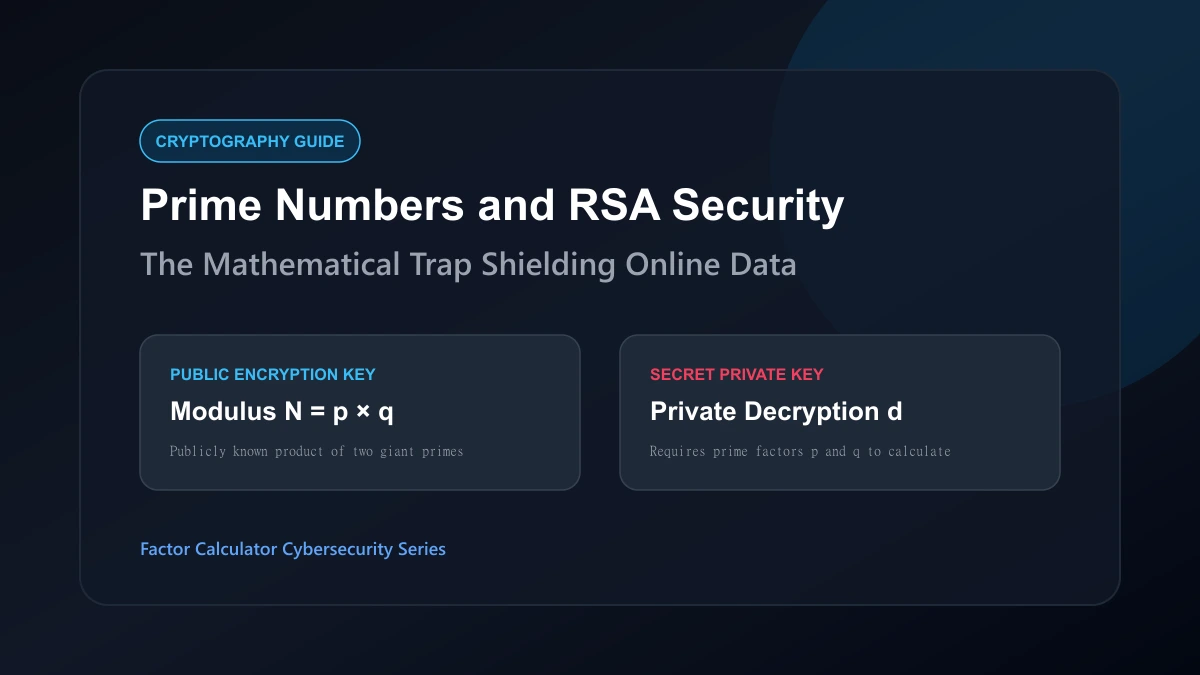
Every time you shop online safely, math is working behind the scenes. Prime factorization and RSA encryption protect your data using a clever mathematical trap. Here’s how RSA encryption works, explained simply for everyone.
What Is Prime Factorization?
Prime factorization breaks a number down into prime numbers multiplied together. Every composite number has exactly one such breakdown. This uniqueness becomes the mathematical backbone of modern digital security systems.
Small numbers factor quickly, but large integers resist this process stubbornly. That resistance, oddly enough, is exactly what makes prime factorization in RSA so valuable for protecting sensitive information.
How RSA Encryption Uses Large Prime Numbers
RSA encryption multiplies two huge prime numbers together to create a public number called the modulus. This RSA modulus becomes part of your public key, shared openly without risk.
Choosing genuinely large prime numbers, often hundreds of digits long, makes why RSA uses prime numbers clear. The bigger the primes, the harder the resulting product becomes to break apart again.
Why Multiplying Primes Is Easier Than Factoring Their Product
Multiplying two primes takes computers seconds. Reversing that process, called the RSA factorization problem, takes far longer, even for powerful machines. This computational difficulty gap is RSA’s entire security foundation.
This is why factoring is difficult at scale. Integer factorization of huge numbers has no fast shortcut yet discovered, making cryptographic security genuinely dependent on pure number theory.
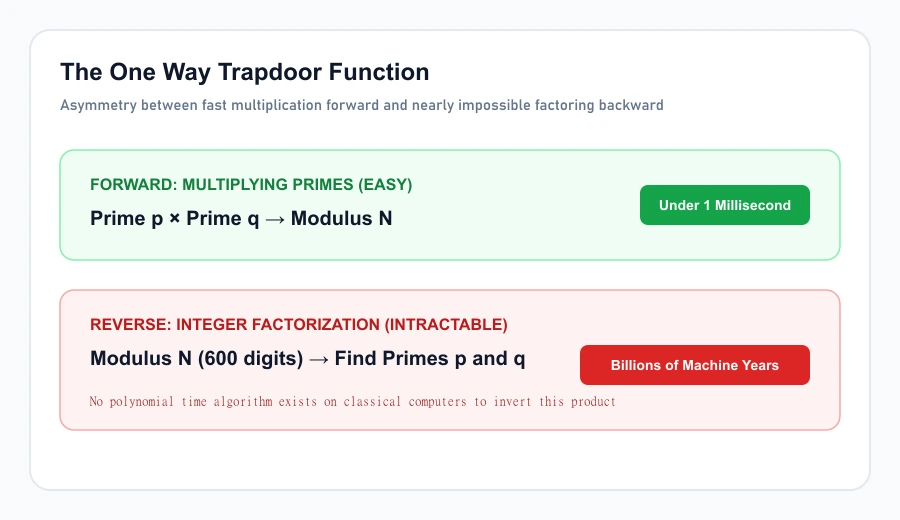
Visual concept showing the mathematical trapdoor between prime multiplication and integer factorization
How Public and Private Keys Work in RSA
Your public key encrypts messages that only your matching private key can decrypt. This asymmetric encryption system lets anyone send you secure data without ever sharing secret information first.
| Key Type | Shared? | Purpose |
|---|---|---|
| Public key | Yes | Encrypts data |
| Private key | No | Decrypts data |
This public private key system underlies secure communication across the entire internet, from banking apps to messaging platforms.
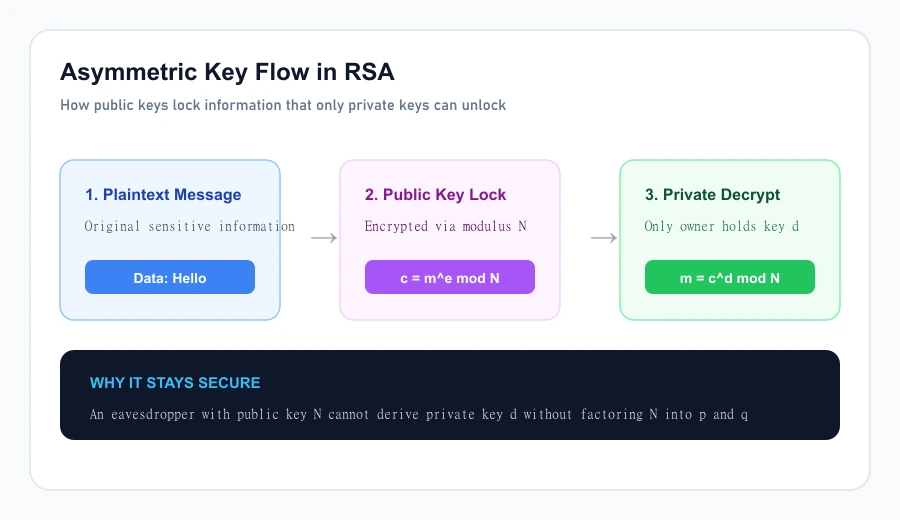
Diagram demonstrating how public keys encrypt data and private keys decrypt messages
How Prime Numbers Support Digital Security
Prime numbers and cybersecurity connect directly through this factoring trap. Without unpredictable, massive primes, encryption would crumble quickly under brute force computing power. This is cybersecurity mathematics at its most practical.
Cryptographic keys built from prime numbers resist attacks precisely because factoring large composite numbers stays computationally expensive, protecting secure data encryption across countless everyday digital transactions worldwide.
How RSA Turns a Mathematical Problem Into Encryption
RSA algorithm steps transform pure math into working technology. Key generation, encryption, and decryption each rely on modular arithmetic operations that only make sense with the right cryptographic key pair.
This is RSA mathematical foundation made practical. What begins as an abstract factoring problem becomes the invisible shield behind HTTPS encryption, SSL cryptography, and everyday secure messaging.
What Role Do Modular Arithmetic and Euler’s Totient Play?
Modular arithmetic in RSA governs how numbers wrap around after reaching a limit, like clock hours resetting. Euler totient RSA calculations determine valid key pairs mathematically, ensuring encryption and decryption stay reversible.
The Euler phi function counts numbers coprime to another, a concept central to RSA key generation. Without this function, building working coprime numbers for secure keys wouldn’t be possible.
Why Large Number Factorization Matters for Cryptography
Large number factorization difficulty scales dramatically as digits increase. A 300 digit number might take longer than the universe’s age to factor with today’s computers, protecting RSA security for now.
This factoring difficulty is precisely why cryptographic protocols demand ever larger keys over time. As computing power grows, so must the prime factor problem size to stay genuinely secure.
How Quantum Computing Could Affect RSA Security
Quantum RSA threat concerns center on Shor algorithm RSA, a quantum method that factors large numbers dramatically faster than classical computers. This could someday weaken current RSA cryptography significantly.
Researchers are already preparing alternatives ahead of this shift. Understanding this quantum computing risk highlights why prime factorization security remains an active, evolving area of cryptography research today.
Conclusion: Why Prime Factorization Matters in RSA
Prime factorization isn’t just abstract math; it protects your passwords, messages, and payments daily. From RSA encryption basics to quantum RSA threat concerns, this number theory foundation keeps modern digital security running smoothly.