Most numbers have an even count of factors, but perfect squares break the pattern. This guide explains why perfect squares have odd factors, using clear examples and simple number theory logic.
What Is a Perfect Square?
A perfect square results from multiplying a whole number by itself. Numbers like 4, 9, 16, and 25 all qualify. Recognizing how to identify perfect squares is the first step here.
Square numbers hold a special property beyond their obvious multiplication origin. Their factor pairs behave differently than regular integers, which leads directly into the odd number of factors puzzle.
How Factors Usually Come in Pairs
Normally, factors pair up neatly. Every small factor matches a larger partner, and multiplying them returns the original number. This factor pair symmetry usually produces an even factor count total.
For 12, pairs are (1,12), (2,6), (3,4). That’s three pairs, six total factors, an even divisor count. This standard factor pairing pattern applies to almost all composite numbers.
Why Square Roots Create an Unpaired Factor
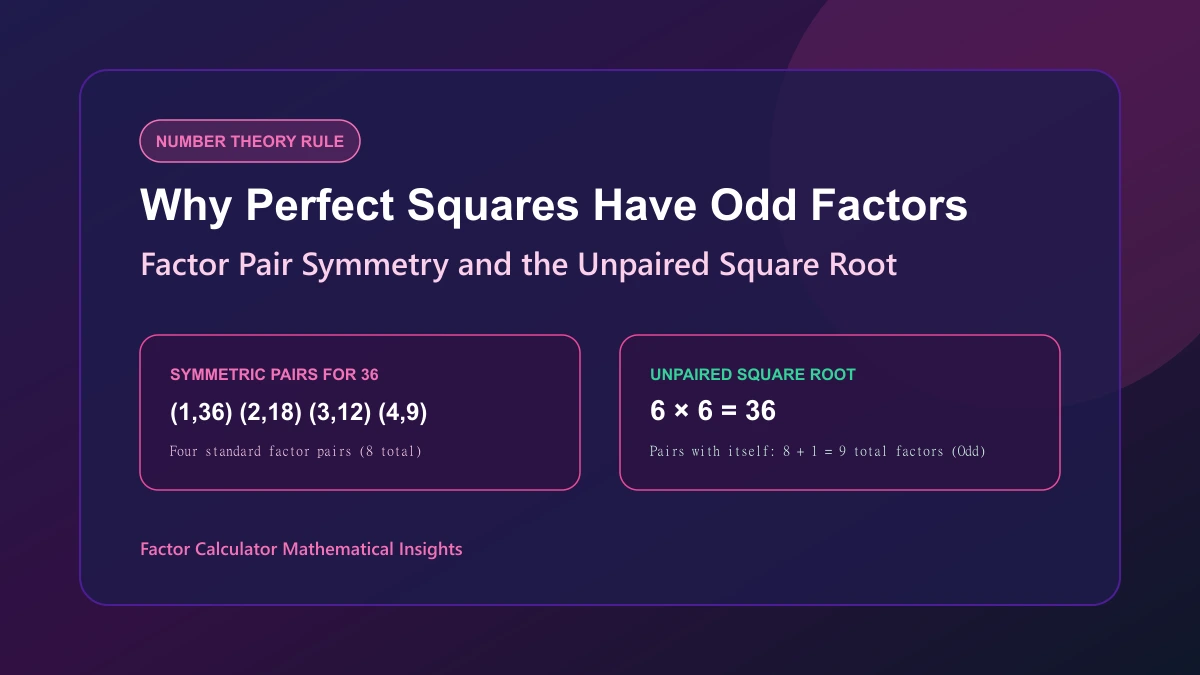
Perfect squares break this symmetry because their square root pairs with itself. This creates one unpaired factor sitting alone in the middle, tipping the total count to odd instead of even.
This square root factor is the entire explanation behind the rule. Without this self paired middle factor, every perfect square would follow the normal even divisor count pattern like other integers.

Diagram illustrating factor pair symmetry and the single middle factor created by the square root
How 36 Demonstrates the Odd Factor Rule
Factors of 36 are 1, 2, 3, 4, 6, 9, 12, 18, 36. Pairs form as (1,36), (2,18), (3,12), (4,9), and 6 pairs with itself, since 6×6=36.
| Number | Factor Count | Perfect Square? |
|---|---|---|
| 25 | 3 | Yes |
| 36 | 9 | Yes |
| 30 | 8 | No |
This confirms why 36 has odd factors exactly nine total.
How to Determine Whether a Number Has an Odd Number of Factors
The fastest test checks whether a number is a perfect square at all. If yes, it guarantees an odd number of divisors. If no, expect an even factor count instead.
This perfect square checker logic saves time versus listing every factor manually. Combined with the divisor count rule, spotting odd factors becomes an instant mental calculation for most students.
How Prime Exponents Explain Perfect Square Divisors
Prime exponents reveal this pattern mathematically. A perfect square always has even exponents in its prime factorization. Adding one to each even exponent always produces odd numbers, and odd times odd stays odd.
For 36 = 2² × 3², exponents are both even. Applying exponent parity logic, (2+1)(2+1) = 9, an odd perfect square divisors count confirming the rule precisely.
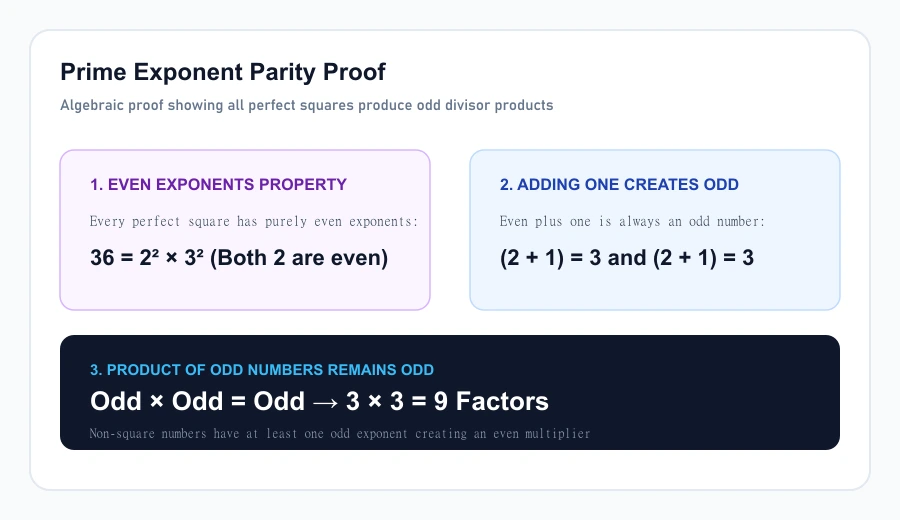
Visual proof showing how even prime exponents in square numbers lead to odd divisor counts
Why Non Square Numbers Usually Have Even Factor Counts
Non square numbers always contain at least one odd exponent in their prime factorization. This breaks the all even pattern, guaranteeing an even divisor count through standard factor pair symmetry.
This is why non square numbers rarely produce odd totals. The single unmatched exponent disrupts the clean pairing that perfect squares enjoy, keeping most integers firmly in even factors territory.
How Factor Pairs Help You Recognize Perfect Squares
Working backward, divisor pairing offers a quick perfect square test. If listing factors ever produces an unmatched middle factor, that number is guaranteed to be a perfect square automatically.
This trick works both directions. Factor symmetry, or the lack of it, tells you instantly whether you’re dealing with a true perfect square or an ordinary composite number.
How the Odd Factor Rule Helps With Number Problems
This odd factors explained rule shows up in competition math, number puzzles, and classroom factor count perfect square problems. Recognizing it instantly saves valuable time during timed number theory tests.
Students who master this perfect square math rule gain a genuine shortcut. It replaces tedious factor listing with instant recognition, a small trick with surprisingly wide factor pattern usefulness.
Conclusion: Why Perfect Squares Have an Odd Number of Factors
Perfect squares stand apart because their square root pairs with itself, breaking normal factor pair symmetry. This simple prime exponent insight explains odd number of factors clearly, turning a tricky rule into easy math intuition.