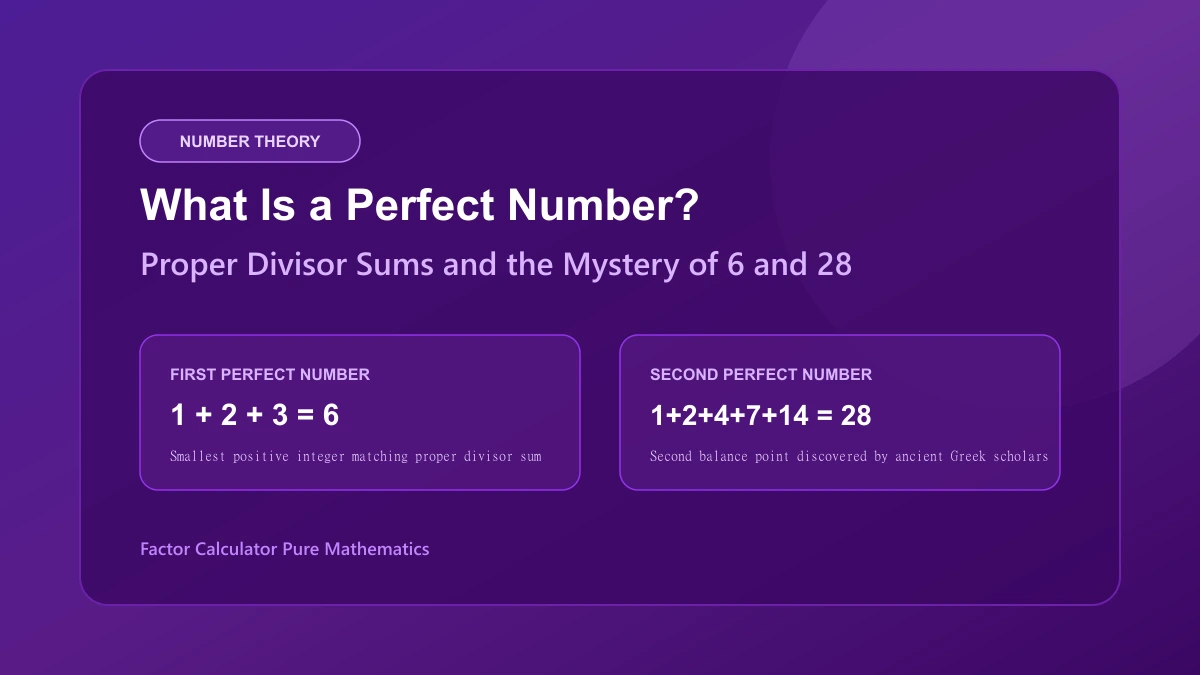
Some numbers feel mathematically balanced, almost magical. A perfect number equals the sum of its own smaller divisors exactly. This guide explores what is a perfect number, using 6 and 28 as friendly examples.
What Is a Perfect Number?
A perfect number is a positive integer equal to the sum of its proper divisors, excluding itself. This divisor sum, sometimes called the aliquot sum, must match the original number exactly.
This isn’t common. Most integers are either abundant numbers or deficient numbers, meaning their divisors sum higher or lower. Perfect numbers sit precisely, rarely, in the mathematical middle.
How to Determine Whether a Number Is Perfect
How to check a perfect number is simple in concept. List all positive divisors except the number itself, add them together, and compare that sum to the original number.
This perfect number test works for any integer, though larger numbers take longer to check manually. This straightforward perfect number algorithm forms the foundation of every perfect number calculator online.
Why 6 Is the Smallest Perfect Number
Factors of 6 are 1, 2, 3, and 6. Removing 6 itself leaves 1, 2, and 3. Adding these gives exactly 6, confirming why is 6 perfect mathematically and elegantly.
This makes 6 the smallest perfect number, and often the very first example taught in number theory classes. Its simplicity makes perfect number examples for students approachable and memorable immediately.
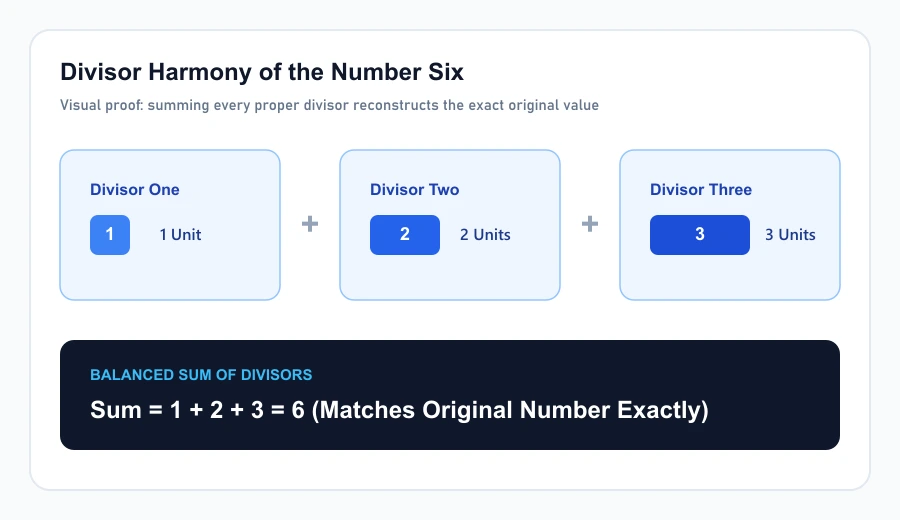
Visual diagram breaking down the proper divisors of six summing to six
How 28 Becomes a Perfect Number
Factors of 28 include 1, 2, 4, 7, 14, and 28. Removing 28 leaves 1, 2, 4, 7, and 14. These add up to exactly 28, proving why is 28 perfect.
| Number | Proper Divisors | Sum |
|---|---|---|
| 6 | 1, 2, 3 | 6 |
| 28 | 1, 2, 4, 7, 14 | 28 |
This table shows the perfect number pattern clearly across both examples.
What Makes Perfect Numbers Different From Other Integers?
Unlike ordinary integers, perfect numbers balance perfectly between excess and shortage. Most numbers lean abundant or deficient, but perfect numbers hit the exact midpoint through their divisor sum theorem structure.
This rarity fascinates mathematicians. Only a handful of perfect numbers exist within reachable ranges, making each new discovery a notable event in recreational mathematics and formal number theory research alike.
How Divisors Reveal the Structure of Perfect Numbers
Every known even perfect number follows a specific formula involving Mersenne primes. This pattern, proven mathematically, connects divisor patterns directly to a special class of prime numbers.
Studying factor patterns within perfect numbers reveals deep number theory structure. This isn’t random coincidence; it’s governed by the elegant Euclid Euler theorem, explored further below.
What Are Even and Odd Perfect Numbers?
Every perfect number discovered so far is even. No odd perfect number has ever been found, despite centuries of searching. This unsolved puzzle is called the odd perfect number problem.
Mathematicians have proven any odd perfect number, if it exists, would need extraordinarily specific properties. This ongoing perfect number conjecture remains one of math’s most stubborn open questions today.
How Perfect Numbers Connect to Mersenne Primes
The Euclid Euler theorem proves every even perfect number comes from a Mersenne prime using a specific formula. Finding new Mersenne primes directly produces new perfect numbers automatically.
This Mersenne prime perfect numbers connection links two seemingly separate number theory branches. It’s a beautiful example of how prime numbers and perfect numbers intertwine mathematically.
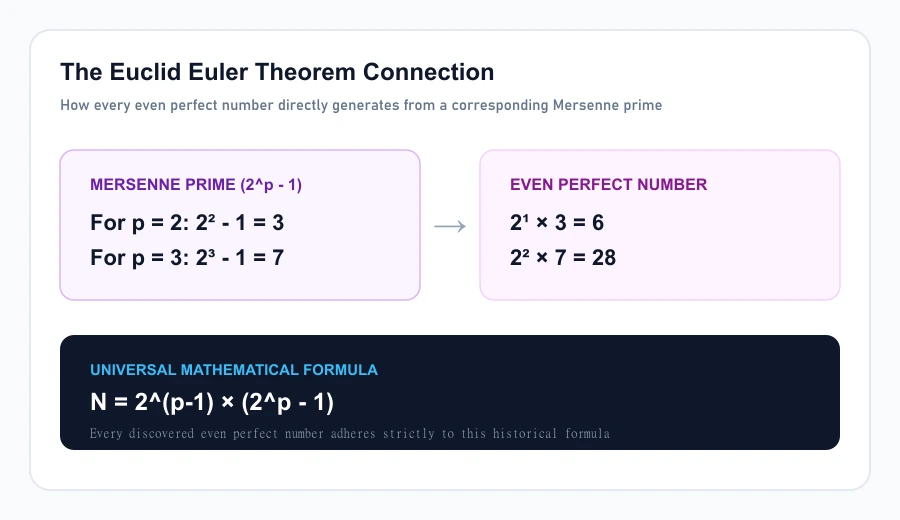
Diagram showing how Mersenne primes generate even perfect numbers using the Euclid Euler formula
Why Mathematicians Still Study the Mystery of Perfect Numbers
Despite being known since ancient Greece, perfect numbers still hold unanswered questions. The odd perfect number problem alone keeps researchers engaged using modern computing and classical number theory methods.
This ongoing perfect number research shows math isn’t finished evolving. Even simple sounding concepts like perfect numbers can hide genuine mystery, making them a favorite topic in mathematical curiosities discussions.
Conclusion: What Makes 6 and 28 Perfect Numbers?
Perfect numbers like 6 and 28 showcase math’s hidden elegance. Through proper divisors, the divisor sum, and connections to Mersenne primes, these special numbers remain a fascinating corner of number theory exploration.