Two numbers, one shared story. Learning greatest common factor and least common multiple unlocks fractions, scheduling, and real math confidence. This guide shows how to find GCF and how to find LCM using simple, reliable methods.
What Are GCF and LCM?
GCF, or greatest common divisor, is the largest number dividing two integers evenly. LCM, the least common multiple, is the smallest number both integers divide into. Together they explain most number relationships.
Both concepts rely on common factors and common multiples. Understanding this GCF LCM relationship early makes fraction work, ratio problems, and even scheduling puzzles far easier to solve with confidence.
How to Find the GCF by Listing Factors
GCF using factors starts with a common factor method. List every factor of both numbers, then spot the largest shared value. This factor lists comparison is simple, visual, and beginner friendly.
For 12 and 18, factors are 1,2,3,4,6,12 and 1,2,3,6,9,18. The shared factors are 1,2,3,6. The greatest common factor is 6, found through simple GCF calculation.
How to Find the LCM From Multiples and Factors
LCM using factors relies on a multiple lists approach. List multiples of each number until one repeats in both lists. That repeated value becomes your least common multiple answer.
For 4 and 6, multiples are 4,8,12,16 and 6,12,18. The common multiples first match at 12. This LCM calculation method works well for smaller number theory problems.
How Prime Factorization Makes GCF and LCM Easier
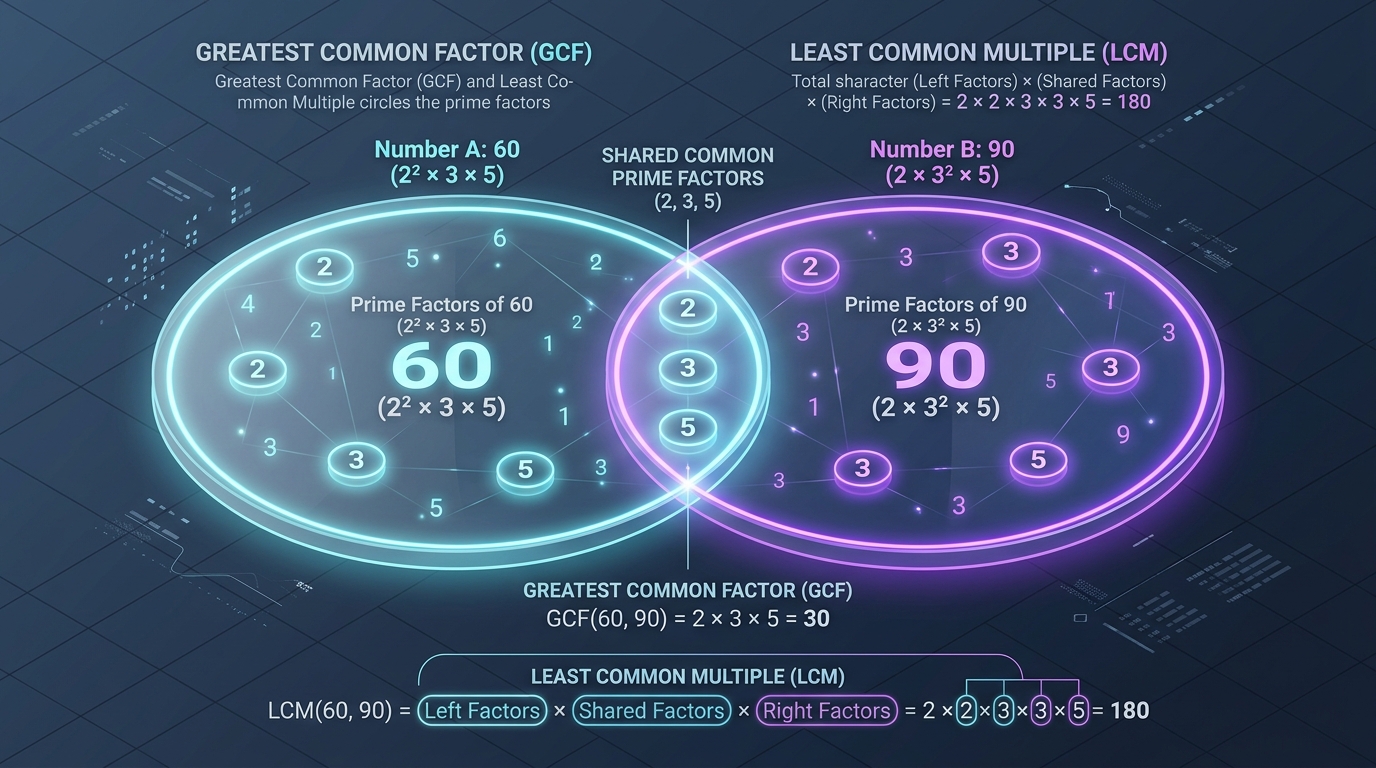
Prime factorization speeds up both calculations significantly. Break each number into prime factors, then compare. Shared primes build the GCF, while all primes combined build the LCM.
A = 60 → 2×2×3×5. B = 90 → 2×3×3×5. Shared primes give GCF(60,90) = 2×3×5 = 30. All primes combined give LCM(60,90) = 2×2×3×3×5 = 180.
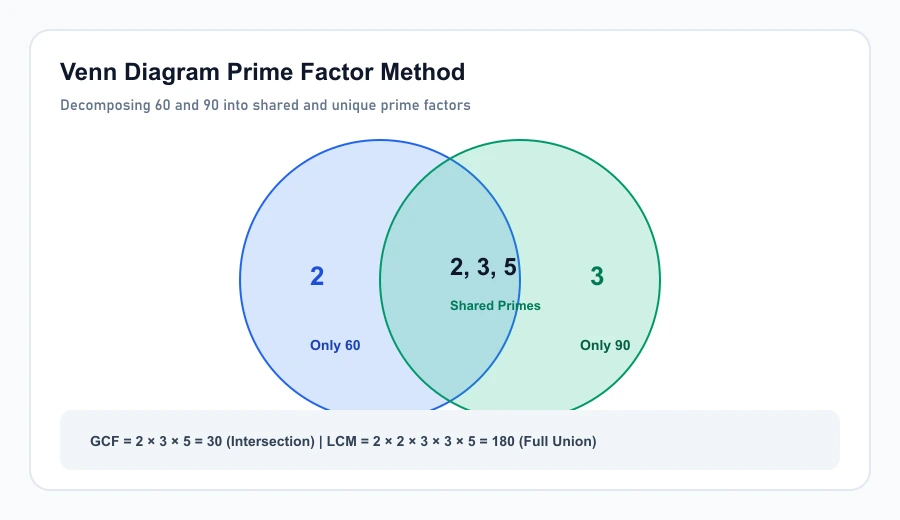
Venn diagram comparison showing shared primes for common factors and combined primes for multiples
How to Solve GCF and LCM Problems With Examples
| Numbers | GCF | LCM |
|---|---|---|
| 12, 18 | 6 | 36 |
| 60, 90 | 30 | 180 |
| 8, 12 | 4 | 24 |
This GCF LCM examples table shows the factor method in action. Practicing with real pairs builds strong arithmetic factors intuition faster than memorizing rules alone.
How GCF and LCM Are Connected Mathematically
An elegant formula links both values: GCF times LCM equals the product of both numbers. This GCF LCM formula offers a shortcut once you already know one of the two values.
For 12 and 18, GCF(6) times LCM(36) equals 216, matching 12×18. This number theory relationship shows common divisor and common multiple concepts are two sides of one coin.
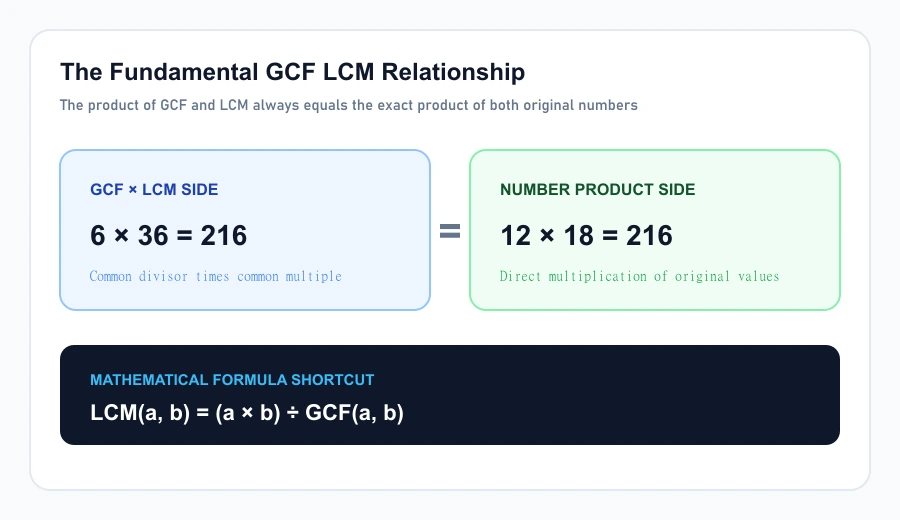
Mathematical diagram illustrating the relationship where common factor times common multiple equals the number product
When Should You Use GCF Instead of LCM?
Use GCF when simplifying fractions or dividing items into equal, smaller groups. Use LCM when combining repeating events or finding a shared denominator. This GCF versus LCM distinction guides every word problem.
Recognizing when to use GCF versus when to use LCM saves confusion. Grouping problems lean GCF; timing or common denominator problems lean LCM, almost without exception in standard GCF LCM problems.
How GCF and LCM Help With Fractions and Scheduling
Fraction GCF simplifies messy fractions down cleanly. Meanwhile, LCM word problems solve scheduling puzzles, like two buses leaving at different intervals and meeting again later at the same stop.
This event scheduling LCM logic and simplify fractions GCF logic show real world value. These aren’t abstract GCF LCM lesson ideas; they solve genuine daily planning and math problems.
How to Avoid Common GCF and LCM Calculation Errors
A frequent mistake confuses GCF with LCM, picking the smallest shared number instead of largest, or vice versa. Careful common factor identification and common multiple identification prevents this entirely.
Double checking with the GCF LCM shortcuts formula catches errors fast. Practicing GCF LCM practice questions regularly builds the sharp instinct needed to avoid these swaps for good.
Conclusion: Finding GCF and LCM Using Factors
GCF and LCM aren’t just textbook terms; they’re practical tools. Whether listing factor lists, using prime factorization, or applying the GCF LCM formula, these GCF LCM steps make number relationships clear and useful.